


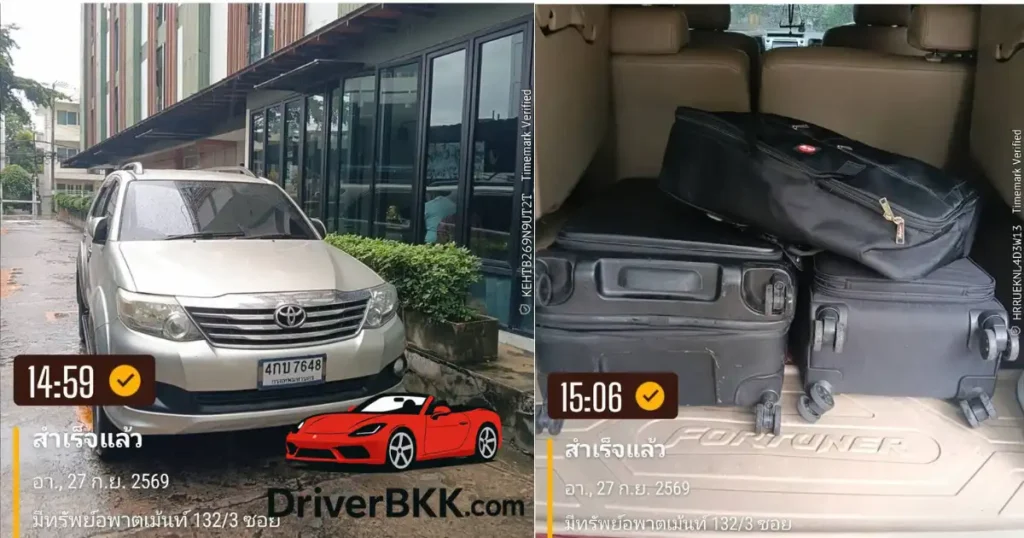
Lat Phrao Car Rental with Driver to Phatthanakan 44
Lat Phrao car rental with driver was the service arranged by DriverBKK for a one-way journey to Phatthanakan Soi 44 on 29 September 2026. The booking involved one passenger travelling with three large suitcases in a Toyota Fortuner. The passenger wanted a comfortable vehicle, and the quoted service included the driver, fuel and expressway tolls. This review explains the confirmed booking details and what a similar passenger should consider before arranging a private transfer across Bangkok.
A short city transfer can require more planning than its description suggests. The passenger count was low, but the luggage requirement was significant. Choosing a vehicle simply because only one person was travelling would have overlooked an important part of the booking. In this case, the useful starting point was the combination of comfort, luggage and the agreed pickup and destination areas.
This is an account based on the service information supplied by the DriverBKK team. It does not contain a passenger testimonial. The booking information confirms that there was no change of plan, but it does not record the exact driving route, pickup time or journey duration. Those details are therefore not presented as facts. The practical advice throughout the article is guidance for similar bookings, rather than additional events attributed to this particular trip.
Lat Phrao Car Rental with Driver: Booking at a Glance
The confirmed booking can be described clearly without revealing the passenger’s identity or exact residential address. The pickup area was Lat Phrao, the destination was Phatthanakan Soi 44, and the service was a single one-way transfer. The selected vehicle was a Toyota Fortuner. One passenger and three large suitcases were included in the booking information.
For readers comparing services, the cost inclusions are as important as the vehicle name. The information supplied for this job states that the driver, fuel and expressway tolls were included. It does not state that parking, extended waiting, extra stops or a return journey were included. Those items should be discussed when requesting a similar quotation.
A booking summary gives future customers a useful reference, but it is not a universal package. Another pickup address, a different departure time or additional luggage could produce a different vehicle recommendation and quotation. The purpose of reviewing this job is to show how a real requirement was defined, not to suggest that every Lat Phrao transfer has identical conditions.
| Service date | 29 September 2026. |
|---|---|
| Pickup area | Lat Phrao, Bangkok. |
| Destination | Phatthanakan Soi 44, Bangkok. |
| Service type | One-way private transfer. |
| Vehicle | Toyota Fortuner. |
| Passengers | One. |
| Luggage | Three large suitcases. |
| Included | Driver, fuel and expressway tolls. |
| Plan changes | None reported in the supplied booking information. |
What the Passenger Needed from This Lat Phrao Transfer
The specific preference recorded for the passenger was a comfortable vehicle. That requirement should not be reduced to a marketing adjective. In practical booking terms, comfort means choosing a suitable vehicle, arranging a usable seat and making sure the luggage requirement does not undermine the passenger area. It also means explaining the service clearly enough that the customer knows what has been booked.
The record does not explain why the passenger was going to Phatthanakan Soi 44. It would be unnecessary to invent a business meeting, hotel transfer, relocation or holiday itinerary. What matters for this review is the transport requirement itself: one person wanted a comfortable private journey and needed to bring three large suitcases.
That combination makes the luggage discussion central. A customer travelling alone may still need more luggage space than a group carrying only small bags. Passenger numbers and baggage volume answer different questions. The first concerns safe seating; the second concerns usable storage and loading. A sensible quotation takes both into account before confirming a vehicle.
One Passenger Does Not Always Mean a Small-Car Booking
A common shortcut in transport planning is to match a solo traveller with the smallest available car. That can work for some journeys, but it is incomplete when luggage has not been discussed. One passenger with three large suitcases has a different requirement from one passenger with a handbag or a cabin bag.
The useful question is not simply whether a smaller vehicle could carry a person. It is whether the intended vehicle can accommodate that person and the actual luggage in a suitable arrangement. Suitcase dimensions, shell shapes and other items can affect the answer. A vehicle label alone does not resolve those details.
For this job, DriverBKK’s supplied record identifies a Toyota Fortuner as the vehicle used for the service. The review does not claim that every sedan would have been unsuitable. It shows that the booking was described with both comfort and baggage in mind, which is a better basis for comparison than passenger count alone.
Three Large Suitcases Are a Material Booking Detail
The luggage quantity is confirmed as three large suitcases, but no dimensions or weights were supplied. That distinction matters. Three bags described as large are not necessarily identical in size, and a customer’s description may differ from a driver’s understanding. For future bookings, dimensions or a photograph can make the discussion more precise.
Customers should describe the luggage that will actually travel. Additional handbags, shopping bags, backpacks or unusual items should be included if they affect storage. The objective is not to make a reservation complicated. It is to avoid a situation in which the vehicle arrives for one declared baggage load and is expected to carry something materially different.
In this review, the luggage description remains exactly what the team confirmed: three large suitcases. No claim is made about their brand, weight or how they were arranged inside the vehicle. The practical lesson is that baggage information belongs in the initial request, alongside the pickup address and passenger count.
Why a Toyota Fortuner Featured in This Booking
The Toyota Fortuner was the vehicle selected for this one-way service. The booking linked that choice with the passenger’s request for comfortable travel and the stated luggage requirement. Those are meaningful reasons to discuss a larger vehicle, but they do not justify calling it the best option for every traveller or every Bangkok route.
A useful vehicle recommendation considers the actual unit available, its seating arrangement, the luggage and the customer’s needs. A model name can guide the discussion, but it should not replace confirmation. Customers who specifically want a Fortuner should ask whether that model can be confirmed for their service date and what happens if an alternative needs to be proposed.
This review also avoids assumptions about the vehicle’s model year, trim, drivetrain or accessories. None of those details was included in the supplied record. The confirmed fact is the vehicle model. The broader advice is to request any feature that matters to the journey rather than assume it is present because of the name on the booking.
Comfort Should Be Matched to the Passenger
People use the word comfortable in different ways. One passenger may value a quiet ride, another may care about seat position, and another may need easy entry and exit. A booking team can make a better recommendation when the customer explains the priority rather than relying on a general request alone.
The passenger in this job asked for a vehicle that was comfortable to sit in. The record does not describe mobility restrictions, special seating needs or medical requirements. Those details should not be added to the review. For a similar booking, however, customers should mention any difficulty entering a vehicle or any arrangement they need before confirming the car.
Comfort also involves the relationship between passenger space and luggage. A proposal should account for where bags will go and whether the required seating remains available. That is why the complete request should be reviewed as one booking, rather than treating the luggage as a minor note added after the vehicle is selected.
Vehicle Space Needs Actual Confirmation
Customers sometimes ask how many large suitcases a particular model can hold. There is no responsible answer based solely on a suitcase count when the dimensions and seating configuration are unknown. The actual vehicle and the planned layout need to be considered together. A generic capacity claim may be misleading for a customer’s specific bags.
For this job, the record states one passenger, three large suitcases and a Toyota Fortuner. It does not provide a loading photograph or measurements. The article can describe the booking, but it should not convert that description into a promise that every Fortuner booking will accept any three bags called large.
For future reservations, send the number of bags and their approximate dimensions. If the luggage includes unusually rigid cases, sports equipment or other oversized objects, mention that separately. The provider can then assess the request and confirm a suitable vehicle arrangement instead of relying on an ambiguous description.
Understanding the Lat Phrao Pickup Area
Lat Phrao was the pickup area given for the booking, rather than an exact published address. That is appropriate for a service review that does not need to reveal where the passenger lives or stayed. A future customer, however, will need to supply a more precise pickup location privately when requesting or confirming the service.
An area name helps identify the general request; a map pin and entrance description help the driver reach the correct meeting point. An apartment building, housing development or other property may have more than one entrance. The nearest landmark may also differ from the place where a vehicle can actually stop.
The review does not identify the entrance used in this job or claim that the team followed a particular access procedure. The practical point is that pickup accuracy matters for a private transfer. A clearly agreed meeting point makes the service easier to coordinate and allows the customer to prepare luggage at an appropriate location.
A Map Pin and a Pickup Instruction Serve Different Purposes
A map pin can identify a building or property, but it may not explain the usable vehicle entrance. Written instructions can provide the missing detail: the gate number, driveway, lobby or agreed waiting area. Combining the two is more useful than assuming the map alone resolves every access question.
If a passenger is travelling with three large suitcases, the meeting point should also allow loading without unnecessary obstruction. This does not mean the provider can guarantee access to every doorway. It means the customer and team should discuss the practical pickup arrangement before the journey begins.
For a future Lat Phrao booking, an accurate pin and a short description are usually more helpful than a long message about unrelated landmarks. Give information that changes where the driver should go. If access depends on security approval or a building procedure, explain that directly so the arrangement can be considered before confirmation.
Pickup Privacy and Booking Accuracy Can Coexist
A public review does not need the passenger’s full address, name or contact information to be useful. The neighbourhood, destination area, date, vehicle and luggage requirement provide sufficient context for understanding the job. Publishing private details would add little value to someone researching a similar service.
A confirmed reservation is different. The provider needs enough information to perform the work, and that information should be shared through the booking channel rather than placed in a public comment. Customers can describe the general route publicly while giving the exact meeting point privately.
For this article, Lat Phrao remains the published pickup description. No hotel, residential project or building name has been invented. That keeps the account aligned with the supplied information and allows the review to focus on the transport problem: a comfortable one-way journey for one passenger carrying three large suitcases.
The Destination: Phatthanakan Soi 44
The destination recorded for the service was Phatthanakan Soi 44. As with the pickup, a street or soi description is useful for a public review but may not be enough to operate a booking. A future passenger should provide the exact destination pin and any relevant access details when arranging the transfer.
A driver may need to know which entrance to approach or where the passenger expects to get out. The appropriate stopping point depends on the actual property and local conditions. Without those details, an article should not claim door-to-door access to a particular building or describe a precise unloading arrangement.
The supplied record does not include the passenger’s final property, so this review does not identify one. It keeps the destination at the confirmed level of detail. That still gives readers a relevant route example: a private transfer from the Lat Phrao area to Phatthanakan Soi 44, rather than an airport or interprovincial journey.
Keep the Final Address Separate from the General Route
The general route helps a booking team understand the request. The final address allows the actual service to be coordinated. Both are useful, but they should not be treated as interchangeable. A quotation based on a broad destination area may need review when the exact location and additional requirements are supplied.
Customers should also distinguish between a destination and an extra stop. If a passenger needs to collect keys, meet someone or visit another location before reaching the final address, that should be explained before confirmation. The driver should not discover that the original one-way transfer has become a multi-stop service only after departure.
No extra stop was confirmed for this reviewed booking. The article therefore does not create one. Its practical recommendation is to describe the requested journey as it will actually happen, including any stop that forms part of the customer’s plan, so the provider can quote and arrange the appropriate service.
What Was Included in the Lat Phrao Car Rental with Driver
The confirmed inclusions were the driver, fuel and expressway tolls. This is useful information because customers comparing private transfers need to understand the complete quoted service, not just the car model. A price that includes certain costs cannot be compared fairly with another price until the inclusions are matched.
Included expressway tolls do not establish which roads were used on the day. The booking record does not identify the actual route. The accurate statement is that those tolls were included in the agreed price, rather than that the car definitely used a particular expressway or passed a particular toll gate.
The supplied information also does not provide the amount charged. This article therefore does not invent a fare. Readers interested in the same general route should request a current quotation using their date, pickup point, destination, passenger count and baggage details. That produces a relevant offer rather than an unsupported price copied from a different job.
Clarify Parking and Waiting Before Booking
Parking was not confirmed as an inclusion for this job. Neither was an extended waiting allowance. For a future transfer, a customer should ask how those items are handled if they might arise. A clear written response is more useful than assuming that every cost associated with travel is included.
Waiting also needs a defined context. Time required for the normal agreed pickup is different from a customer asking the vehicle to remain available for an appointment or an additional task. The booking team should explain the relevant terms rather than leaving both parties to interpret a vague promise of flexibility.
This article does not state a waiting fee, a grace period or a parking policy because those details were not supplied. The recommendation is simple: make potentially chargeable requirements visible before confirming the booking. It protects the customer from an unexpected assumption and gives the provider a fair opportunity to quote the requested work.
No Change of Plan Was Reported
The supplied information states that the plan did not change. That fact can be included without turning it into an unsupported performance claim. It means no change of plan was reported in the record used for this review. It does not, by itself, prove a particular arrival time or journey duration.
Similarly, the article does not claim that the transfer was faster than another transport option or that traffic conditions were unusually favourable. Those comparisons would require information that is not available here. A credible review can explain a booking clearly without adding dramatic results to make the service sound more impressive.
The useful takeaway is that the job remained described as a one-way service from Lat Phrao to Phatthanakan Soi 44. Future customers should still understand how changes would be handled if their own plans differ. Additional stops, a new destination or a request to wait should be agreed with the provider before becoming part of the service.
Real Photographs and the Limits of This Service Review
The team reported that real photographs exist and that permission to publish them was obtained. The photographs have not been supplied within this article, so the text does not describe details supposedly visible in them. When the images are added, captions should identify what each photograph actually shows.
A vehicle photograph can support the vehicle description. A luggage photograph, if available, may illustrate the loading arrangement. Neither should be given a caption that claims more than the image and booking record establish. Personal faces, addresses, number plates or other identifying details should be handled according to the publication permission and the purpose of the image.
This review contains no quoted passenger feedback. Although the form indicated that feedback existed, the original wording was not provided. The account therefore remains a service review written from team information. That is enough to explain the booking without manufacturing a testimonial or turning a general note about feedback into a customer endorsement.
What This Lat Phrao Booking Shows
The clearest lesson from this job is that passenger count should be considered alongside luggage and comfort preferences. One traveller with three large suitcases may benefit from a different vehicle discussion than a traveller with a small bag. An accurate request gives the booking team a stronger basis for proposing a suitable arrangement.
The second lesson concerns scope. This was one-way transport, and the confirmed inclusions were the driver, fuel and expressway tolls. Keeping those details explicit makes the offer easier to understand. It also helps a future customer ask about any requirements that were not part of this particular job.
For an overview of the provider and its services, visit DriverBKK. When requesting a similar transfer, describe your actual journey rather than simply asking for the same car. The next part explains how to prepare that request, compare service options and avoid misunderstandings before confirming a private transfer across Bangkok.
Booking Lat Phrao Car Rental with Driver for Your Own Journey
A review can help you recognise a service that resembles your needs, but your quotation should be based on your own itinerary. The reviewed job involved one passenger and three large suitcases travelling to Phatthanakan Soi 44. If any of those details differ for your booking, include the difference in your enquiry rather than expecting the same arrangement automatically.
Start with the service date, requested pickup time, exact pickup point and exact destination. Then add the passenger count and luggage description. If comfort is a priority, explain what that means for you. A request for a particular vehicle can be considered, but it should be confirmed by the booking team rather than treated as guaranteed from an article.
This approach gives the provider a usable brief. It also reduces the need for repeated messages, because the details that affect vehicle selection and service scope are visible from the beginning. A short, complete enquiry is often more useful than a long message that leaves the luggage, destination or waiting requirement uncertain.
Prepare a Complete Pickup Description
A practical pickup description should tell the team where the journey starts and where the passenger will meet the vehicle. Include the address or map pin, the property name where relevant, and any entrance instruction that changes the driver’s approach. Keep the message focused on the details needed to locate the agreed meeting point.
If the building has restricted access, explain the procedure you know about. If a security desk needs a name or if loading must happen in a designated area, share that information before the service. The provider can then discuss what can be arranged instead of making assumptions about entry rights or stopping permissions.
A pickup instruction should also be realistic. The most convenient doorway may not be a suitable vehicle stopping point. The agreed location should allow the passenger to meet the car and load luggage without creating an avoidable obstruction. Confirm the actual arrangement privately, especially when the journey begins at a residence or another location containing personal information.
Provide a Destination That Can Be Used Operationally
Writing Phatthanakan Soi 44 describes the general destination, but a future booking needs the final location. Add the exact address or pin and identify the relevant entrance if there is more than one. This allows the team to understand the journey being requested rather than quote for an area with an unknown final stop.
Explain whether the destination is the end of the service. If the vehicle needs to wait or continue elsewhere, say so before confirming. A one-way transfer and a car retained for later travel are different requirements. Clear instructions prevent a customer from expecting ongoing availability after a service that was arranged only to reach one destination.
The destination does not need to be published in a public review. The booking team can use it privately while the article describes the route at neighbourhood level. That separation makes it possible to coordinate the service accurately without exposing the passenger’s full itinerary to people who only need a general example.
Give Both Pickup Time and Any Important Deadline
The time you want to leave and the time you need to arrive answer different questions. If there is an important appointment, share its time as well as your preferred pickup time. The team can then discuss whether the requested departure leaves a reasonable margin based on the information available when the journey is planned.
An estimated journey time should be treated as an estimate. Conditions can change between quotation and departure, and a route estimate is not a promise that traffic will remain the same. Customers who have a fixed deadline should make that priority clear and be open to a proposed earlier departure if needed.
No pickup time or deadline was supplied for the reviewed job. The article therefore does not attach a duration to it. For your own request, however, timing information is essential. It lets the provider assess a specific journey instead of trying to infer an appointment from a route name or a vague request for quick travel.
Lat Phrao Car Rental with Driver: Choosing the Service Type
A customer asking for a car with a driver may mean several different things. They might need one transfer, a return journey, a vehicle waiting during an appointment or a series of stops throughout the day. Those are not interchangeable services, even when the same vehicle model could be used for each.
The reviewed booking was a one-way transfer. Its purpose was transport from the pickup area to the destination, rather than keeping the car available for an entire day. Readers who need additional availability should request that explicitly. The provider can then explain the service format and price that fit the intended use.
Choosing the right format is not about selecting the longest package. It is about paying for the work you need and understanding the limits of that booking. A precise itinerary helps the team avoid underestimating the job and helps the customer avoid buying a service that does not match the plan.
When a One-Way Private Transfer Makes Sense
A one-way transfer is appropriate to consider when there is one pickup and one final destination, with no need to retain the vehicle afterwards. The customer can concentrate on the required arrival while the provider quotes for the defined journey. That is the service format reflected in this review.
If you have three large suitcases, a one-way transfer can still be suitable. Luggage affects the vehicle discussion, not automatically the number of hours you need to book. A customer should avoid confusing a larger vehicle requirement with a need for a full-day arrangement unless the itinerary genuinely requires that availability.
Before confirming, ask what the quoted transfer includes and how changes are handled. If a brief planned stop forms part of your journey, disclose it. If there is no extra stop, state that too. The result is a booking description both sides can understand, rather than a single label that leaves important operational details unstated.
When an Hourly Booking May Be More Suitable
An hourly arrangement may be worth discussing if the vehicle needs to remain available while you attend an appointment or move between several places. In that situation, the provider is reserving time as well as arranging transport. The quotation needs to reflect the actual schedule and the boundaries of the service.
Customers should ask what period is covered, where the vehicle can operate during that time and what happens if the booking runs longer. None of those terms should be assumed from the phrase car with driver. They need to be part of the provider’s offer for the specific job.
This review does not state an hourly rate or imply that an hourly package was used on 29 September 2026. The guidance is for readers whose own plans differ. If you are uncertain which format fits, describe the itinerary and let the team compare suitable options rather than choosing a package before the actual work is clear.
A Return Journey Needs Its Own Agreement
A trip to Phatthanakan Soi 44 does not automatically include a return to Lat Phrao. If you need to come back, provide the expected return time and explain whether it is fixed or uncertain. The team can then discuss whether to arrange two transfers or another service format that fits your day.
This matters because a vehicle booked for one departure may have other commitments later. A customer should not assume that the same car can remain available simply because it completed the outward journey. Availability, waiting and the return itinerary need to be agreed rather than added informally after arrival.
The reviewed service remains a single one-way journey. A future reader can use it as a reference for vehicle and luggage discussions, but should request a separate quotation for a return plan. Making that distinction before payment helps avoid a mismatch between the service reserved and the transport the customer expects.
Selecting a Vehicle for One Passenger and Three Large Suitcases
Vehicle selection should begin with the actual load and the passenger’s needs. One person with three large suitcases is a clear brief, but suitcase dimensions and any additional items can still matter. A provider needs enough information to decide whether the requested car and seating arrangement are appropriate.
A customer may prefer a Fortuner because of a previous experience or because that model appears in a similar review. That preference can be included in the enquiry. It should be followed by a request for confirmation that the intended unit and luggage arrangement suit the current booking, rather than a general assumption about every vehicle carrying that name.
If another vehicle is proposed, compare its suitability against the original requirements. The important questions concern usable passenger seating, baggage accommodation, access and price inclusions. A substitution should not be assessed only by brand reputation or whether the replacement belongs to the same broad category.
Why Suitcase Dimensions Can Improve the Quote
The word large is convenient but imprecise. A rigid suitcase, an expandable bag and an oversized case can occupy different amounts of space even when customers use the same description. Approximate dimensions give the booking team a better starting point, particularly when several bags must travel together.
You do not need to measure every small personal item for an ordinary enquiry. Focus on the objects most likely to determine vehicle space. For three large suitcases, provide approximate length, width and height if available, or send a photograph that makes their relative size clear. Mention any unusual shape separately.
The reviewed job does not contain measurements, so its luggage count should not be used as a universal capacity test. A future reservation should be assessed using the luggage that will actually travel. This is a practical check before confirmation, not a reason to create a complicated specification for a straightforward passenger transfer.
Tell the Team About Additional Bags
A booking for three suitcases should not quietly become three suitcases plus several unmentioned boxes. If there are backpacks, shopping bags or other items that will affect loading, tell the team. Accurate information allows a suitable arrangement to be discussed before the driver arrives at the pickup point.
The same principle applies if your packing changes after reservation. Send an updated message and ask whether the existing vehicle remains appropriate. The provider can review the change while there is still an opportunity to adjust the booking, rather than discovering a larger load when the service is already due to begin.
This review confirms three large suitcases and does not add other baggage. For similar journeys, the most useful habit is to describe the complete load once it is known. The goal is a workable passenger service, with luggage accommodated appropriately, rather than a negotiation at the curb over which bags were included in the original message.
Secure Storage Matters More Than a Marketing Capacity Claim
A statement that bags will fit is not the whole loading question. The arrangement should also preserve the passenger’s usable seat and allow the driver to operate the vehicle appropriately. Loose objects and obstructive placement should not be treated as an acceptable solution to an underestimated baggage requirement.
Customers can ask how the luggage will be accommodated, especially when travelling with several large items. The answer should refer to the actual proposed vehicle and arrangement. A photograph from another trip may be useful context, but it cannot guarantee that differently shaped bags will load in the same way.
The supplied information for this job does not document the loading layout. The article therefore avoids describing folded seats or a particular storage configuration as if it had been observed. The advice for future customers is to confirm suitability beforehand and let the provider assess the physical arrangement instead of relying on an advertising headline.
Comfort Requirements for Lat Phrao Car Rental with Driver
Comfort can be discussed in specific terms without promising an identical experience for every person. Explain whether you are concerned about seating, vehicle entry, cabin conditions or keeping the passenger area separate from luggage. The team can then consider those priorities when proposing a car and confirming the service.
A vehicle that suits one passenger may not suit another with different access needs. For example, a customer who has difficulty stepping into a higher vehicle should raise that issue rather than assuming that a larger vehicle is automatically more comfortable. The appropriate choice depends on the person as well as the luggage.
The passenger in this review asked for comfortable seating, but the record contains no additional personal needs. The guidance here is therefore general. A useful reservation makes relevant requirements explicit before the vehicle is assigned, allowing the provider to respond with a concrete arrangement instead of a vague assurance that the car is comfortable.
Explain Mobility or Boarding Needs in Advance
If you need assistance entering or leaving a vehicle, explain what support is required when enquiring. The booking team can discuss whether the proposed arrangement is suitable and whether the service can meet that request. Do not assume that every private transfer includes specialised assistance or equipment.
Similarly, if you use a mobility aid, state its type, approximate size and whether it can be folded. That information affects both passenger access and storage. The provider should assess the combined requirement rather than treat the aid as an ordinary bag that can be added without discussion.
There is no indication that the reviewed passenger required mobility assistance. This topic is included because readers planning a similar route may have different circumstances. Its purpose is to help customers describe their own needs accurately, not to add a passenger characteristic or a service capability that has not been confirmed for this particular job.
Ask About Features You Actually Need
If a feature matters to your journey, ask whether it is available in the proposed vehicle. Examples may include a particular seat arrangement, charging access or a requested cabin preference. Such features can vary between individual vehicles, so a model name should not be treated as a complete list of equipment.
The reviewed booking does not confirm Wi-Fi, bottled water, charging ports or other amenities. Those items are therefore not advertised as part of this service account. A future customer who needs one should request a direct answer from the team and include the agreement in the booking details where relevant.
This is a more useful approach than choosing a car based on an imagined specification. Focus on requirements that affect your journey, then confirm them. It gives the provider a chance to explain what is available and avoids disappointment caused by assumptions drawn from unrelated photographs, different trim levels or another customer’s experience.
Comparing Lat Phrao Car Rental with Driver Prices
A meaningful price comparison begins with equivalent service scope. Compare the same pickup, destination, date, vehicle requirement, passenger count and luggage load. Then check the inclusions. A lower headline price may describe a different service rather than a better offer for exactly the same journey.
For the reviewed job, the confirmed price included the driver, fuel and expressway tolls. The amount itself was not supplied. Readers should therefore request a quotation rather than infer a fare from this article. The team can assess the requested date and itinerary and state the relevant terms for that booking.
Price clarity also means understanding potential changes. Ask how extra stops, waiting, a different destination or additional luggage would be handled if relevant to your plan. An offer is easier to judge when both the included work and possible adjustments are explained before confirmation, rather than left to interpretation on the day.
Compare the Total Service, Not Just the Starting Figure
Two quotes may both mention a car and driver but include different costs. One may include fuel and tolls while another lists them separately. To compare fairly, ask for a written description of what you would pay for the planned journey and what could still be added.
You do not need an elaborate financial model for a city transfer. A short checklist is enough: vehicle, route, service format, driver, fuel, tolls, parking, waiting and any requested stop. Where an item is irrelevant, mark it as such. Where it could apply, ask how it is treated.
The purpose is to compare the offer you will actually use. It is not to force every provider to use the same packaging. Once the scope is visible, you can weigh price against vehicle suitability and service clarity. A transparent quote allows that decision; a number without context does not.
Make Waiting Expectations Explicit
A customer may need time to bring three large suitcases from a room or storage area to the vehicle. It is sensible to prepare for pickup and understand the provider’s waiting terms. Ask what arrival coordination is included and how additional waiting would be handled if your preparation or appointment takes longer than planned.
Waiting for a passenger to meet an agreed transfer is different from reserving the car during a separate activity. If you need the second arrangement, say so. The booking team can quote the appropriate service rather than interpret a request for a transfer as an open-ended commitment.
No waiting allowance or fee has been provided for this reviewed trip. The article therefore cannot state a fixed policy. For your booking, a clear explanation before confirmation is the useful result. It lets you prepare realistically and understand which changes would require a new agreement or an additional charge.
Clarify Payment and Booking Confirmation
Ask which payment methods are available for your booking and what confirms the reservation. A quote, a provisional discussion and a confirmed service may represent different stages. The customer should know when the date, vehicle and service details have actually been accepted by the provider.
If a deposit or advance payment is required, request the amount, payment instructions and the applicable change or cancellation terms. Keep the confirmation alongside the itinerary. This article does not set a deposit amount or promise a payment method because none was confirmed for the reviewed transfer.
The practical objective is a clear booking record: who is travelling, where the service begins and ends, which vehicle has been agreed, what is included and what payment has been made. That record is more useful than an informal exchange in which the price is mentioned but the service details remain scattered across separate messages.
Route Planning for Lat Phrao to Phatthanakan Soi 44
A route should be planned from the actual pickup and destination, not merely from the two area names. The exact starting point, final entrance and departure time influence the discussion. A booking team can use those details to propose a realistic service, but the route may still need adjustment to current conditions.
This review does not publish a fixed road sequence or claim that a particular expressway was used. The supplied record does not support those details. Future customers should avoid assuming that a named route in an article will always be the most suitable route for their own date and starting point.
The important commercial distinction is between the agreed destination and the operational route used to reach it. The customer should explain any route constraint that matters to them. The provider can then assess that request and clarify any effect on time, price or suitability before confirming a service based on it.
Do Not Treat an Estimated Duration as a Guarantee
Travel estimates are useful for planning, but they depend on assumptions. A prediction based on a map at one moment may differ from conditions at departure. Customers with a fixed appointment should discuss a margin rather than building the entire plan around the shortest displayed estimate.
The reviewed job contains no confirmed duration, so no number is attached to it. Publishing an invented time would make the article appear precise while giving readers a poor planning reference. A future enquiry should request an estimate for the actual pickup time and addresses, together with any relevant uncertainty.
A practical question is whether the proposed departure supports your intended arrival with reasonable allowance for variation. That is more helpful than asking the team to promise a single driving time. It encourages planning around the customer’s real deadline while acknowledging that a private vehicle does not control every condition along the way.
Expressway Inclusion and Route Choice Are Separate Questions
The reviewed quote included expressway tolls. That tells the reader how a potential travel cost was treated, but it does not prove the route taken. Customers should distinguish between a cost inclusion and an instruction that the driver must use a particular road regardless of conditions.
For a future service, explain if you have a specific route requirement. Otherwise, discuss the intended destination and any deadline, then allow the team to assess suitable routing. A customer may care most about cost certainty, comfort or arrival planning, and those priorities can be addressed without fixing every road in advance.
The article does not recommend a specific toll road for the Lat Phrao to Phatthanakan Soi 44 journey. Such a recommendation would need the actual locations and current conditions. Its useful point is that toll inclusion should be written clearly in the quote, so any route decision does not create confusion about the agreed price.
Rain and Access Conditions: General Advice, Not a Claim About This Trip
No confirmed flood incident forms part of the reviewed job. Earlier examples about flooded roads were not treated as verified events, so this article does not describe the Fortuner driving through floodwater. General weather advice is included only to help readers prepare for their own journeys.
If heavy rain or an access problem affects your pickup point, tell the team what you know. Describe the location and obstruction accurately rather than simply saying the area is difficult. The provider can then discuss whether the agreed meeting point remains suitable and whether an alternative should be considered.
A larger vehicle should not be presented as permission to enter unsafe water. Vehicle height alone does not establish that a flooded road is suitable to use. The practical aim is to arrange a safe, workable journey and a clear meeting point, not to promise that a particular model can overcome every condition at the customer’s doorstep.
Share Access Changes Before the Vehicle Arrives
If a gate is closed, roadworks block an entrance or the normal pickup point becomes unavailable, send an update promptly. Include a revised pin or a clear description where possible. Information received before arrival gives the team a better chance to adjust the meeting arrangement.
Customers should also distinguish an access update from an entirely new itinerary. Moving to another entrance of the same property is not necessarily the same change as relocating the pickup to a different neighbourhood. The provider needs to understand the actual change before confirming whether the original arrangement still applies.
No access change was reported for the reviewed transfer. This advice concerns future bookings. Its value lies in avoiding a preventable coordination problem: the driver following the original instruction while the passenger waits somewhere else. A concise, confirmed update is more effective than assuming that both sides will discover the change independently.
Agree an Alternative Meeting Point When Necessary
If the original location cannot be used, discuss a suitable alternative with the provider. The location should be identifiable and practical for the passenger, luggage and vehicle. Do not move the meeting point without telling the team, particularly when three large suitcases make an improvised walk difficult.
An alternative point is a proposed arrangement until it has been agreed. Confirm where the passenger should wait and how the driver will identify the location. If the change affects the route or service scope, ask whether it also changes the quotation rather than assuming the original terms automatically apply.
This article does not invent an alternative pickup for the September booking. It shows the type of communication that may be needed for another journey. The same principle applies to changes at the destination: accurate information and an explicit agreement are more useful than a vague expectation that the driver will resolve every new condition without discussion.
A Practical Enquiry for Lat Phrao Car Rental with Driver
A well-prepared enquiry can be brief. State the date, pickup time, exact locations, passenger count, luggage and service format. Then add the vehicle preference and any requirement that materially affects the job. Ask for the total price and a written description of what is included.
For a booking similar to the reviewed transfer, your message might say that you need one-way transport from Lat Phrao to Phatthanakan Soi 44 for one passenger with three large suitcases. Specify that you prefer a Toyota Fortuner and want the quotation to identify the treatment of fuel, tolls, parking and waiting.
Do not copy the reviewed date unless it is actually your travel date. An example request is a template, not a booking instruction. Replace the route details and baggage description with your own information, then wait for the provider’s confirmation before treating the vehicle or price as reserved.
Copy-and-Edit Enquiry Template
Hello DriverBKK. I would like a quotation for a one-way private transfer from Lat Phrao to Phatthanakan Soi 44.
Travel date: [your date].
Requested pickup time: [your time].
Pickup address and map pin: [your location].
Destination address and map pin: [your location].
Passengers: [number].
Luggage: [number, approximate sizes and other items].
Preferred vehicle: Toyota Fortuner, subject to confirmation.
Additional stops or waiting: [describe, or state none].
Important arrival time or access needs: [describe if relevant].
Please confirm vehicle availability, luggage suitability, the total quotation and what is included. Please also explain any applicable parking, waiting, change and cancellation terms.
This template keeps the request concrete. It gives the team information that changes the service rather than asking for a general price with an unknown itinerary. Customers can use it for another destination as well, provided the locations and other details are updated accurately.
Review the Confirmation Before Travel
Once the provider responds, compare the confirmation with your request. Check the date, time, pickup, destination, vehicle and baggage description. Read the price inclusions and any conditions that apply to your itinerary. Correct a mismatch before treating the reservation as complete.
If your plan changes later, update the team and retain the revised confirmation. This is especially important when adding luggage, stops or waiting, because those changes may affect the suitability of the original vehicle or service format. A shared written record helps both sides work from the same version of the plan.
For more information about service formats, read DriverBKK’s car rental with driver information. The final part of this article addresses common questions, explains how to interpret service evidence and brings the actual Lat Phrao booking back into focus without inventing a customer testimonial or unsupported performance result.
Lat Phrao Car Rental with Driver: Questions Before You Book
The questions below relate to the reviewed service and to customers planning a similar private transfer. Where a fact belongs to the actual booking, it is stated directly. Where a condition depends on a new reservation, the answer points to the information that needs confirmation instead of creating a company policy from an incomplete record.
That distinction is important for customers. A review can show that a certain service was arranged, but it cannot confirm future vehicle availability, a new fare or every term that might apply to another itinerary. Treat it as a practical reference and obtain a written offer for your own journey.
For a straightforward enquiry, keep the core details together: date, time, locations, passengers, luggage and service type. If you have a firm appointment or special requirement, include it early. The answers here will help you identify what to ask, while the booking confirmation should provide the final terms for the service you choose.
Can I Book a One-Way Transfer from Lat Phrao to Phatthanakan Soi 44?
The reviewed job was a one-way transfer on that general route. It involved a Toyota Fortuner, one passenger and three large suitcases on 29 September 2026. For a new date, request availability and a quotation using your exact pickup and destination details.
A route review is not an availability calendar. The provider needs to check your requested time and vehicle before confirming the reservation. If you have flexibility, mention it, but do not assume that a different date or departure time will have the same price or arrangement.
Also state whether the destination ends the service. If you need a return journey, waiting or another stop, add that to the enquiry. This allows the team to propose a booking that reflects your actual plan rather than an apparently simple transfer that contains additional requirements only disclosed later.
Is Toyota Fortuner Available for Every Lat Phrao Booking?
This review confirms a Toyota Fortuner for the recorded job; it does not guarantee that model for every future reservation. Customers who want that vehicle should ask the team to confirm availability for the specific service date and time.
Ask how the model will be described in the confirmation and whether any alternative would require your agreement. If a replacement is proposed, assess it against your comfort and baggage requirements. The relevant question is whether the proposed arrangement meets the booking, not simply whether another vehicle belongs to a similar category.
No model year, trim or equipment list was supplied for this job. If a feature is important, request it explicitly. That avoids relying on a photograph of a different unit or an assumption about equipment that may vary between vehicles used for private transfers.
Will Three Large Suitcases Fit in the Vehicle?
The reviewed booking specifies three large suitcases travelling with one passenger in a Toyota Fortuner. It does not provide suitcase dimensions or a loading layout, so it should not be treated as a universal luggage-capacity promise.
For your booking, send the baggage count and approximate sizes, together with any other items. The team can assess the requested load against the actual proposed vehicle and seating arrangement. If the suitcases are unusually shaped or oversized, make that clear before confirming.
The number of available passenger seats and the usable luggage space should be considered together. A solution that works for one traveller may not work for several passengers with the same bags. That is why copying the car model from this review is not enough to establish suitability for a different group.
Was the Price Inclusive of Fuel and Expressway Tolls?
Yes. The information supplied for the reviewed service states that the driver, fuel and expressway tolls were included in the quoted price. The fare amount was not supplied, and the article does not invent one.
For a new quotation, ask for the same items to be described clearly. If you are comparing providers, make sure each offer refers to the same itinerary and vehicle requirement. A number that excludes a relevant cost should not be compared as though it were identical to an inclusive offer.
The inclusion of tolls does not identify the route used on the day. It describes the agreed treatment of those costs. A future customer can ask about routing priorities separately, especially if there is a specific deadline or constraint that should influence how the journey is planned.
Are Parking Fees Included?
Parking fees were not confirmed as an inclusion in the reviewed booking information. They should therefore not be described as included in this service account. A future customer should ask how parking is handled if it may be relevant to the pickup, destination or planned waiting.
It is useful to ask that question before payment, when the full service scope is being discussed. A clear answer allows you to understand the total expected cost or the circumstances in which an additional charge could arise.
Do not assume that a package including fuel and tolls includes every other travel-related cost. Providers may structure quotations differently. The practical requirement is an understandable written offer for your itinerary, so you can assess the price and avoid relying on an inclusion that was never agreed.
Can I Add an Extra Stop During the Transfer?
Ask the team before confirmation if an extra stop is part of your plan. Give its location, purpose and expected waiting requirement. The provider can then assess whether the service remains a suitable transfer arrangement or needs a different quotation.
No additional stop is confirmed for the reviewed job. The article therefore cannot say that stopovers were included, complimentary or permitted under a particular allowance. An extra stop changes the work requested and should be handled as part of the agreement.
If the need appears after reservation, contact the team and obtain confirmation of the revised arrangement. Do not assume that the driver can absorb a substantial itinerary change without affecting time or cost. Clear communication gives both sides a workable plan and lets the customer decide whether to accept the updated terms.
What If I Need the Driver to Wait at the Destination?
Tell the booking team how long you expect the vehicle to wait and whether you need another journey afterwards. Waiting at the destination is a different requirement from a one-way drop-off, so it should be included in the requested service.
The reviewed job does not confirm destination waiting. There is no basis for stating a waiting allowance, rate or automatic extension. For your reservation, ask whether an hourly booking, a return transfer or another arrangement would be more appropriate.
If your finishing time is uncertain, explain that rather than selecting an unrealistically precise return time. The provider can describe available options and applicable limits. This gives you a service suited to the day you expect, instead of a transfer whose scope ends before your transport needs do.
How Far in Advance Should I Book?
Request the service once your essential travel details are known, especially if you want a specific vehicle. The team can check availability and explain the booking requirements for your date. This review does not establish a fixed minimum notice period.
Earlier enquiry can create more time to discuss luggage, pickup access and any special needs, but it is not a guarantee of availability. If your date is close, state that clearly and wait for an explicit confirmation rather than treating an unanswered enquiry as a reservation.
If your schedule is not final, ask how provisional requests are handled. There may be a difference between discussing an option and securing a vehicle. Knowing that distinction helps you plan responsibly and avoids assuming that a car is being held while important booking details remain unresolved.
Can I Book for a Passenger Who Does Not Speak Thai?
Tell the team which language the passenger needs for pickup coordination and service communication. Ask what support can be confirmed for the proposed booking. The reviewed job does not establish the passenger’s nationality or the driver’s language capabilities.
A company website in English is not, by itself, a promise that every assigned driver provides the same level of spoken English. A customer who needs direct communication should request confirmation rather than infer it from the article language.
Provide a usable contact method and clear meeting instructions. If another person is arranging the booking, explain how the passenger will receive the confirmation and contact details. The goal is to give the traveller a practical way to identify the car and communicate essential information, using an arrangement the provider has actually agreed to supply.
Can Someone Else Arrange the Transfer for Me?
A person arranging transport for another passenger should tell the team who is booking and who will travel. The provider can then explain what contact information is needed for the reservation and pickup. The reviewed record does not specify who made the booking, so no arrangement is attributed to this job.
Keep the passenger’s essential itinerary and baggage information accurate. If the traveller has three large suitcases, do not describe the luggage as a generic bag simply because the person making the enquiry has not seen it. Confirm details with the passenger before requesting a final vehicle recommendation.
Make sure the traveller receives the pickup instruction and knows how to reach the agreed contact. A booking can be commercially confirmed yet still difficult to coordinate if the passenger has no usable information on the day. Sharing the relevant confirmation privately helps the service begin from a common understanding.
Does a Private Transfer Include a Tour Guide?
A driver and a tour guide are different service requirements. The reviewed booking confirms transport with a driver, fuel and expressway tolls; it does not confirm a guide or a sightseeing programme. Those services should not be added to its description.
If you need guided sightseeing during a different itinerary, explain that when requesting a quote. Ask what can be arranged and how it affects the booking. A private vehicle does not automatically include guided interpretation, attraction admission or an organised tour.
For general destination research, you can consult the Tourism Authority of Thailand’s official website. That resource is separate from DriverBKK’s transport service and does not verify this particular job. Use it for travel information, then give the provider the concrete itinerary you want quoted.
Is This an Airport Transfer Review?
No. The reviewed route was Lat Phrao to Phatthanakan Soi 44. It was not described as a journey to or from an airport, and the article does not create an airport stop to match an unrelated search term.
If your own itinerary includes an airport, request that service separately with the relevant flight and meeting details. Do not assume that the pickup instructions for a city address apply inside an airport terminal or that this reviewed quote covers a different route.
Keeping the review specific makes it more useful. Readers looking for a private transfer across Bangkok can see the actual requirement without being drawn into an invented airport narrative. Other service types can be discussed with the provider using their own locations, timing and baggage information.
Can the Vehicle Drive Through Flooded Roads?
This article does not claim that the reviewed Fortuner drove through floodwater. A flood event was not confirmed for this job. A future service should assess road and access conditions rather than rely on vehicle height as proof that a flooded route is suitable.
If you know of an affected location, inform the team and discuss alternatives. The objective is to establish a workable meeting point and route, not to guarantee passage through uncertain water conditions. A customer should not choose a private transfer on the basis of an unsupported flood capability claim.
The confirmed booking was not reported as having a change of plan. That fact does not establish what weather occurred, and it should not be used to infer a successful crossing of a hazardous area. Accurate booking information and responsible route decisions are more useful than a dramatic story without evidence.
What Does “No Change of Plan” Mean in This Review?
It means the team-supplied information reported no change of plan for the reviewed job. It does not establish a precise arrival time, traffic condition or comparison with another transport option. Those details were not supplied and are not claimed.
A service account can describe the agreed route and vehicle without promising an outcome beyond the record. Readers should be wary of treating a simple booking note as evidence for a broader guarantee, such as every journey arriving within an identical period.
For your own trip, confirm how an itinerary change should be communicated and whether it affects the price. Even if you expect no changes, understanding that process is useful. It provides a clear way to handle a genuine new requirement rather than assuming a previous review’s unchanged plan predicts your own day.
Is There a Customer Testimonial for This Job?
No customer quotation is included in this article. The supplied form indicated that feedback existed, but the original text was not provided. The review therefore describes the service from the team’s information without attributing words or a rating to the passenger.
If the original feedback is later added with publication permission, it should be presented accurately and distinguished from the article’s own commentary. A paraphrase should not be placed in quotation marks as though it were the customer’s exact wording.
The same principle applies to satisfaction claims. The record does not support a statement that the customer gave five stars, praised punctuality or said the car was exceptionally comfortable. A credible service review can still be helpful by explaining the actual booking and the decisions relevant to someone considering a similar transfer.
What to Look for in a Lat Phrao Car Rental with Driver Confirmation
Before confirming a reservation, look for a coherent description of the service. The date and pickup time should match your request. The locations should identify the intended journey. The passenger and luggage details should reflect what will travel. The vehicle and price inclusions should be understandable without relying on guesses.
A confirmation should also make relevant conditions accessible. If waiting, cancellation or changes could affect your booking, ask for the applicable terms. The article does not supply universal conditions on the provider’s behalf; it identifies the matters a customer should understand when accepting an offer.
If something remains unclear, ask a specific question rather than restarting the entire enquiry. For example, request confirmation that three declared suitcases can be accommodated in the proposed vehicle or ask whether a particular parking cost is included. A precise question helps resolve the uncertainty and keeps the booking discussion focused on the actual service.
Keep One Current Version of the Itinerary
A booking may begin with a rough plan and become more detailed through messages. Once it is confirmed, keep a clear final version containing the relevant itinerary and terms. This helps prevent an old address, an earlier departure time or an outdated luggage count from being mistaken for the current instruction.
If you change something, request an updated confirmation or a clear acknowledgment of the change. Avoid relying on a message that announces a new requirement but receives no response. The provider needs to confirm that the revised work is understood and can be arranged under the agreed or updated terms.
For the reviewed job, the latest confirmed baggage description is three large suitcases. That illustrates why a service account should use the corrected information rather than repeat an earlier version. For customers, the same habit makes a reservation easier to operate: one shared plan, with any meaningful revision clearly recorded.
Understand What Evidence Can Actually Demonstrate
A photograph can show a vehicle or a setting, but it does not prove every aspect of a service. A booking record can identify the itinerary and inclusions, but it may not establish the passenger’s opinion. A testimonial can report an individual’s experience, but it should not be rewritten as a guarantee for all future customers.
When evaluating a review, look for specific facts that answer your booking questions. For this job, those facts are the service date, route, vehicle, passenger count, luggage and confirmed price inclusions. They are more useful for assessing similarity than a general statement that everything was perfect.
This article keeps those evidence types separate. It does not invent an observed loading configuration, reproduce a missing testimonial or use an unrelated official website as verification of the service. That makes the review a clearer starting point for a customer who needs to request and evaluate an actual offer.
A Solo Traveller’s Preparation for Three Large Suitcases
If you are travelling alone with several large suitcases, prepare the pickup logistics as well as the booking details. Consider how the bags will reach the agreed meeting point and what access is available. Tell the team about a material loading constraint before the service rather than assuming it will be obvious on arrival.
Keep essential personal items and travel information accessible. The purpose is practical organisation, not a claim that this reviewed passenger followed a particular packing method. Customers can use the advice to make their own departure easier while relying on the provider for the confirmed vehicle arrangement.
If you expect help beyond ordinary transport coordination, ask what can be provided. Carrying bags down stairs or moving items through a building may involve a different requirement from loading at the vehicle. Clear discussion allows the team to respond honestly and prevents a passenger from expecting a service that was not included in the quote.
Check the Luggage Description Before Departure
Review the baggage information in your confirmation once packing is complete. If you declared three large suitcases and that remains correct, the booking team is working from the intended description. If the load has changed, notify the provider and ask whether the arrangement still suits it.
This final check is especially useful when a trip involves purchases, equipment or items collected shortly before travel. Small changes may be straightforward, but a substantial increase should not be left for the driver to assess at pickup. The team can consider vehicle space while there is still time to discuss an appropriate response.
The reviewed booking’s luggage count is three, not one. That is a material detail because it changes how readers understand the vehicle requirement. For your own journey, an accurate final baggage description serves the same purpose: it connects the service reserved with the load that will actually arrive at the meeting point.
The Practical Value of This Lat Phrao Service Review
This job is a useful example because its requirements are specific. The passenger was travelling alone, wanted a comfortable vehicle and had three large suitcases. The route was Lat Phrao to Phatthanakan Soi 44, and the agreed service was one-way transport in a Toyota Fortuner.
Those details help a reader decide whether the example resembles their needs. They do not establish a universal fare, a fixed journey time or guaranteed availability. A customer can take the relevant questions from the review and apply them to a new request with the correct date, locations and luggage.
The account also demonstrates how much can be explained without a fabricated testimonial. Vehicle selection, service scope, inclusions and booking preparation are real topics that matter to customers. An honest description gives readers a better basis for enquiry than adding an invented quote or an unverified claim about exceptional results.
Comfort, Luggage and Scope Belong in the Same Conversation
The most useful booking discussion considers the complete requirement. Comfort alone does not specify the car. Passenger count alone does not describe the luggage. A route alone does not explain whether the vehicle must wait or continue elsewhere. Each detail contributes to the actual service that needs to be arranged.
In the reviewed job, the combined brief was one passenger, three large suitcases, a preference for comfortable travel and one-way transport to Phatthanakan Soi 44. That is a more informative starting point than simply asking for a vehicle in Lat Phrao.
For a future customer, the practical action is to give the provider that complete picture. The team can then respond with a proposed vehicle, a service format and a quotation that relate to the work. It is a simple booking habit with a clear benefit: fewer assumptions between the enquiry and the confirmed journey.
Request Lat Phrao Car Rental with Driver from DriverBKK
If you need a private transfer from Lat Phrao, send DriverBKK your travel date, requested pickup time, exact locations, passenger count and luggage details. Mention whether you want a one-way service, a return journey or a vehicle available for additional stops. Ask the team to confirm a suitable arrangement and the full quoted inclusions.
For a requirement similar to this review, explain that you are one passenger travelling with three large suitcases and would like a Toyota Fortuner, subject to availability and luggage confirmation. The team can assess your actual request instead of relying on the route name alone.
Read about the available service formats on the car rental with driver service page or visit DriverBKK for more information. To enquire about your journey, call 081 546 1696 Confirm your itinerary, vehicle and quotation with the team before treating the booking as reserved.
